

The GUT Matrix is one of the most widely used tools worldwide. In fast-paced environments, prioritization has never been more necessary—or more challenging. Regardless of company size, dozens or even hundreds of tasks can arise daily. Deciding what to tackle first without a structured method can lead to poor decisions.
That is exactly why the GUT Matrix is so popular. It is simple, easy to use, and provides clarity in decision-making. It helps create priority lists by organizing what needs to be done first. For these reasons, more professionals—whether involved in management systems or not—are adopting this tool.
In this article, we will explore this powerful and practical tool. By the end, you will understand how to use it, its key aspects, and its importance. It is straightforward enough to apply immediately after reading.
What is the GUT Matrix – severity, urgency, and trend?
The GUT Matrix is a tool developed by Charles H. Kepner and Benjamin B. Tregoe, renowned experts in problem-solving. Originally designed for prioritizing problems, it has since expanded to all areas of management. It is also known as the Kepner-Tregoe Matrix.
The methodology focuses on three simple factors: severity, urgency, and trend. By limiting variables, it helps prevent decision paralysis when facing multiple options.
This tool was widely used in American and Japanese industries during the golden age of quality management. Today, it remains closely linked to quality management and continuous improvement practices and is widely used in offices and decision-making scenarios.
Severity, urgency, and trend
Handling multiple tasks often creates confusion. The more information we add, the harder it becomes to decide. The GUT Matrix stands out for its simplicity by focusing on three factors:
- Severity: How serious is the issue? For example, a roof leak may be more severe during heavy rain.
- Urgency: How quickly must the issue be addressed? What happens if action is delayed?
- Trend: What will happen if no action is taken? Will the problem escalate or create additional risks?
The GUT calculation (severity × urgency × trend = priority)
The key advantage of the GUT Matrix lies in its scoring system. Each factor is rated from 1 to 5:
Severity scale:
1 – Not serious, insignificant impact
2 – Slightly serious, minor impact
3 – Moderately serious
4 – Very serious
5 – Extremely serious, critical impact
The same scale applies to urgency and trend. The final priority score is calculated by multiplying the three factors.
Example:
- Severity: 5
- Urgency: 3
- Trend: 2
Priority score: 30 (5 × 3 × 2)
Higher scores indicate higher priority.
Simple GUT Matrix example
Consider the following task list:
- Prepare risk report
- Address nonconformity “D”
- Send certification emails
- Purchase office supplies
- Organize workstation
- Schedule management review meeting
After assigning scores and calculating G × U × T:
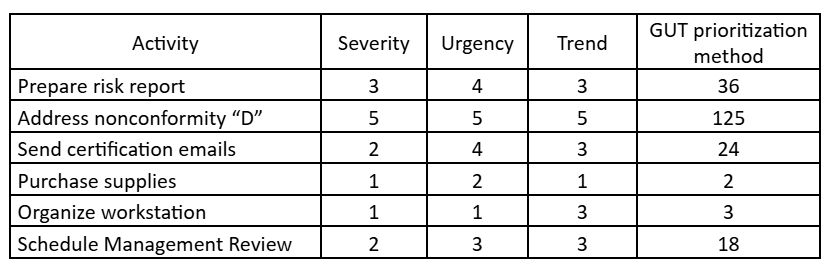
The task with the highest score should be prioritized first.
GUT Matrix – simplifying chaos
Regardless of whether you have 5 or 50 tasks, the GUT Matrix provides clear and comparable scores. It helps prioritize what matters most and postpone low-impact activities.
The method can be customized—for example, replacing “trend” with “cost” or adding additional criteria. However, the standard model is sufficient for most situations.
Ultimately, the GUT Matrix demonstrates that even complex scenarios can be structured. It helps eliminate low-value tasks, reduces mental overload, and supports better decision-making.